My Biz: Mortuary Lift Company helps funeral directors make lifts with ease
Lift equipment helps funeral directors work safely worldwide
By STEVE GRAVELLE
Updated
 The Mortuary Lift Company’s John Everett secures cable during assembly of one of the company’s Ultimate 1000 Lifts in its shop and offices in The Cherry Building in southeast Cedar Rapids, Iowa, on Tuesday, July 1, 2025. The company also manufactures a motorized stretcher, with a 375-lbs. capacity for moving remains up and down stairs. It has also introduced a motorized loading tool that uses seat belt connection points as anchors for loading cots into a vehicle.(Jim Slosiarek/The Gazette) JIM SLOSIAREK
It’s the sort of problem you wouldn’t think about unless you’re the one dealing with it.
“When people die at home, you’ve got to lift them” to move them, Katie Hill said. “If they die at a hospital you’ve got to lift them there. In the funeral home, you’ve got to lift them to get them dressed. It is hard lifting, and it’s super awkward.”
“I realized pretty quickly that I could not lift a dead body, and there’s a lot of lifting of dead bodies,” she said.
Hill’s father knew of a California funeral home that had a lift installed on ceiling-mounted tracks, built by a company that made boat hoists. He called the company.
“He said, ‘Can you make me one of these lifts?’” Hill said. “They said, ‘No, but do you want to buy the company? Just buy the inventory.’ I didn’t have the $2,000, so I had to pay him back. It took a while. We got the plans and said, ‘Can you put one of these together?’ And that’s how it went.”
Despite a slow start, 1987 proved a fortunate time for Hill’s new Mortuary Lift Company.
“The industry has changed,” she said. “It’s now over 75 percent female. The funeral home industry has gone the way of every industry. It got bought up, and it’s publicly traded on the stock exchange. Now they are worried about workman’s comp. Nobody is lifting bodies by hand anymore. I went to the trade shows and I completely changed an industry.”
Hill and her husband Tim Hill, now an attorney with the Bradley & Riley firm, moved their family to his native Cedar Rapids in 1998.
“He was gone every weekend and until 10:00 at night,” she said. He said, ‘I want to be around my kids,’ and we made a lifestyle change.”
The company stayed in Chicago until 2007, when Hill moved it to the historic Cherry Building in the NewBo neighborhood a few months before the June 2008 flood.
“We moved out by Hawkeye Downs for six months, and moved back,” Hill said. “This is a great building. In Chicago I was located in a building that looked exactly like this. When I looked at this building, it had the same feel, and sure enough all these things fit in here.”
After subcontractors bend and weld steel components into shape, they’re delivered via the Cherry Building’s original freight elevator to Mortuary Lift’s second-floor shop, where 10 employees bolt them together and add the electric lifting motors and controls.
“We sell internationally,” although tariffs have cost some recent orders, Hill said. “People die all over the globe, and I’m the only one making lifting equipment for the funeral home.”
 Mortuary Lift Company president/CEO Katie Hill’s daughter Jane models with the company’s motorized stair stretcher The Stepper on a brochure seen in the company’s shop and offices in The Cherry Building in southeast Cedar Rapids, Iowa, on Tuesday, July 1, 2025. The motorized stretcher, with a 375-lbs. capacity, can carry remains up and down stairs. (Jim Slosiarek/The Gazette) JIM SLOSIAREK

Orders are designed to fit the customer’s space, with costs running $15,000 to $20,000.
“It’s probably the cost of one back surgery, and they’re aware of that,” Hill said.
From its original gantry lift bolted to the ceiling, Hill and her staff developed a portable lift that can be wheeled about the work area. A more recent development, the Stepper, is an electrically-assisted dolly for workers collecting a body for transport.
“How are you carrying 250 pounds up and down stairs?” Hill said. “It’s really awkward on a stretcher. Right now, we’ve got a prototype, and I’ve talked to the patent attorney.”
The Tug-Along, a portable electric winch that anchors to a vehicle’s seat belt mounts, has promise beyond the funeral industry.
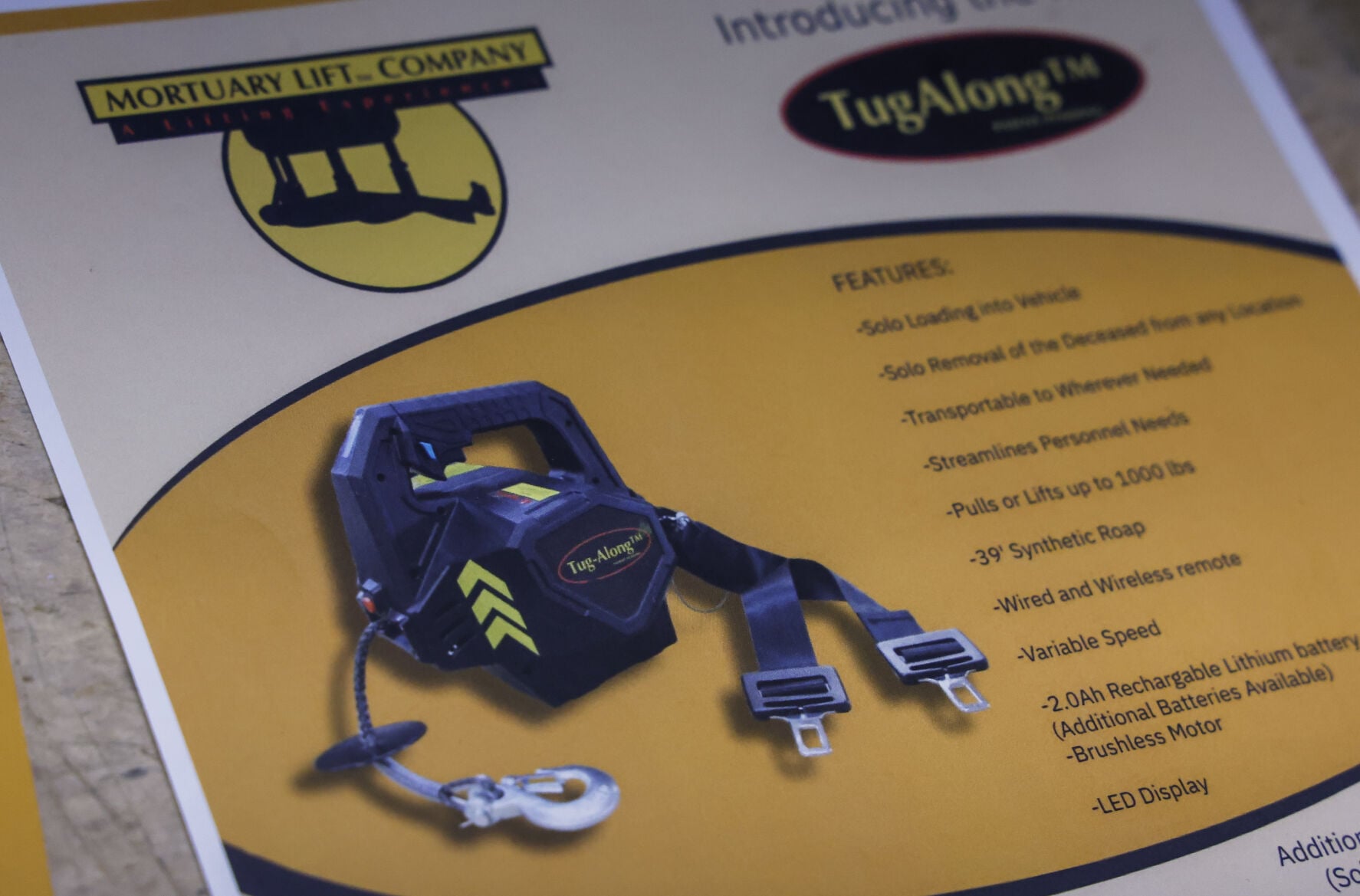
A brochure for the Mortuary Lift Company’s newest device the TugAlong, a motorized loading tool that uses seat belt connection points as anchors for loading cots into a vehicle, is seen at the company’s shop and offices in The Cherry Building in southeast Cedar Rapids, Iowa, on Tuesday, July 1, 2025. The company also manufactures a motorized stretcher, with a 375-lbs. capacity. for moving remains up and down stairs. (Jim Slosiarek/The Gazette)
Competitors have challenged Hill’s company, but not for long.
“I’ve taken them all out of business,” she said. “Every competitor that comes in the business, I always win. We have a terrific product. There’s no built-in obsolescence. We don’t have any warranty issues, because we build a quality product. I stand behind it, and it’s a small industry. If they have an issue, they talk to me.”